Table of Contents
Modern infrastructure projects like airports, metro systems, convention centres, hospitals, and commercial towers increasingly demand building envelope materials that combine structural efficiency, design flexibility, and long-term durability. As project scale and complexity grow, architects and facade engineers are turning more often to honeycomb panels to meet these competing demands.
Named for the hexagonal cell structure that gives them their strength, honeycomb panels moved out of aerospace and transportation engineering and into mainstream architecture over the past two decades. Here is what is driving that shift, and how the material compares with more familiar facade options.
What Are Honeycomb Panels?
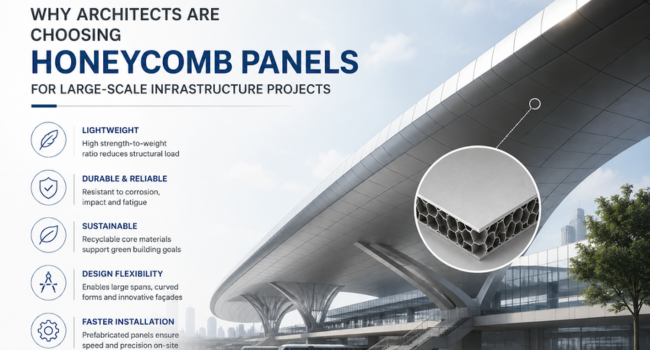
Honeycomb panels are sandwich-structured composites made by bonding two thin metal sheets to a lightweight hexagonal core, typically aluminium. The honeycomb geometry, modelled on the cell structure of a beehive, distributes structural loads evenly across the panel, allowing it to achieve high rigidity and flatness while using far less material than a solid panel of equivalent strength.
Why Large Infrastructure Projects Need Lightweight Materials
Managing structural weight is one of the most persistent challenges in large-scale construction. Expansive façades, ceilings, and cladding systems place real loads on a building’s primary structure, which in turn affects foundation design and overall project cost. The lightweight, high-rigidity profile of honeycomb panels helps on several fronts:
- Reduced dead load on the building’s structural frame
- Smaller foundation and substructure requirements
- Improved seismic performance due to lower mass
- Lower transportation and crane costs during installation
- Easier handling and faster fixing on site
On projects involving thousands of square metres of façade, airports, stadiums, and railway terminals among them, these savings compound across the full scope of work rather than showing up in just one line item.
Strength Without the Weight Penalty
Honeycomb panels achieve their stiffness the same way an I-beam does: by separating two strong, thin face sheets with a low-density core that resists bending and shear. This lets the panel resist wind loads, impact, and other environmental stresses while using a fraction of the material a solid panel would need for equivalent rigidity.
That stiffness also keeps panels flat across larger formats, a meaningful factor on projects with expansive, uninterrupted façade surfaces, where waviness becomes far more visible at scale and dimensional stability is treated as a core specification requirement rather than a cosmetic preference.
Greater Design Freedom for Architects
Large-scale architecture increasingly favours curved surfaces, folded geometries, and cantilevered forms over flat, boxy massing. Because the honeycomb core can be fabricated into custom shapes without losing structural integrity, the material supports this kind of design ambition without adding significant structural complexity. Common applications include large-format façade systems, curved or faceted surfaces, suspended ceilings, interior wall cladding, soffits and canopies, and interior finishes for transport infrastructure.
Fire Safety Is Reshaping Facade Material Choices
Fire performance has become one of the most scrutinised aspects of facade design over the past decade. Following several high-profile cladding fires, most notably the 2017 Grenfell Tower fire in London, regulators in multiple countries have tightened requirements around combustible materials on building exteriors, particularly above certain height thresholds.
Classification systems such as EN 13501-1 rate materials on a scale from non-combustible to readily flammable, and many national codes now require higher-rated materials for tall and high-occupancy buildings. Because the metal core in honeycomb panels does not combust, these panels generally meet stricter non-combustibility classifications more easily than panels built around a solid polymer core, though actual performance still depends on the adhesives and facings used, so test certification should always be confirmed for the exact configuration being specified.
Durability in Demanding Public Environments
Public infrastructure is expected to perform for decades under continuous exposure to weather, pollution, and heavy foot traffic, often with limited opportunity for maintenance shutdowns. The metal face sheets resist corrosion and moisture ingress, and the bonded core does not absorb water or degrade the way some organic-core materials can over time, one reason the format is increasingly specified for transit hubs, civic buildings, and healthcare facilities, where access for repairs can be disruptive and costly.
Sustainability and Lifecycle Performance
Material efficiency has become a measurable specification criterion in its own right. Honeycomb panels support sustainability goals by using less raw material per square metre than solid panels of similar strength, generating lower transportation-related emissions due to reduced weight, and relying on aluminium components that are highly recyclable at end of life. For developers pursuing green building certifications, these factors can support credits tied to material efficiency and embodied carbon.
Honeycomb Panels vs Aluminium Composite Panel Systems
Honeycomb panels are often discussed alongside aluminium composite panel systems, since both fall under the broader category of metal-faced sandwich cladding. The two differ mainly in core construction, and that difference shapes where each is typically specified.
Honeycomb panels use a hollow hexagonal aluminium core, which gives them a very high strength-to-weight ratio and supports larger panel formats with less sub-framing, qualities that make them a frequent choice for airports, stations, stadiums, and institutional facades. A standard aluminium composite panel, by contrast, uses a solid core (polyethylene, mineral-filled, or aluminium, depending on grade), generally tops out at smaller-to-mid-size formats, and is a common choice for commercial buildings, retail fronts, signage, and general cladding. Fire performance follows the same pattern: the metal core in honeycomb panels is inherently non-combustible, though actual ratings still depend on adhesives and facings, while ACP fire performance varies more by core type, with polyethylene cores classed as combustible and fire-retardant or A2-rated cores available where stricter ratings are required. Cost profiles diverge too, honeycomb panels typically carry a higher material cost, often offset by reduced substructure and installation needs, while standard ACP usually has a lower upfront material cost.
Neither material is universally “better”, the right choice depends on span requirements, budget, fire classification needs, and the architectural finish a project is targeting. Many large developments use both: honeycomb panels where structural performance and large spans matter most, and conventional aluminium composite panels for cost-sensitive or smaller-format cladding elsewhere.
Where Honeycomb Panels Are Used in Modern Infrastructure
Adoption spans airports and aviation terminals, metro and railway stations, government and civic buildings, educational institutions, healthcare facilities, commercial towers, exhibition and convention centres, and sports and cultural complexes. Across these sectors, the common thread is a need to cover large surface areas reliably, often under tight construction schedules and strict performance requirements.
The Future of Infrastructure Construction
As infrastructure projects grow in scale and complexity, facade material choice is increasingly treated as a structural and lifecycle decision rather than a purely aesthetic one. Honeycomb panels have gained ground because they address weight, fire performance, durability, and design flexibility together. Whether a project ultimately specifies honeycomb panels, conventional aluminium composite panels, or a mix of both will depend on its structural and budgetary requirements, but large-scale infrastructure is clearly being designed, more and more, around lightweight, high-performance metal panel systems.