Table of Contents
Most dog grooming anxiety is not a behaviour problem. It is a comfort problem. Dull scissors drag through the coat rather than cutting cleanly. Clippers overheat against sensitive skin. Poor-quality tools make the experience physically unpleasant before any amount of training or treats can help. The right tools reduce resistance faster than any reward system alone.
If you have tried every tip, every treat, every soothing voice, and your dog still tenses the moment the grooming kit comes out, you are not doing anything wrong. Neither is your dog. The session is going wrong because of what is in the kit. Dog grooming at home can be calm, consistent and even enjoyable when the tools are doing their actual job.
The Dog That Does Not Want to Be Touched
Grooming resistance is one of the most common frustrations among UK dog owners, and it is almost always blamed on the dog. In most cases, the tools deserve a closer look.
It Usually Starts Younger Than You Think
The first few grooming sessions a puppy experiences set the template for every session that follows. When those early encounters involve tools that catch, pull or make startling noises, the dog learns quickly that being groomed means discomfort. That lesson sticks. What reads later as stubbornness or grooming anxiety is often a well-rehearsed self-protective response that began long before the owner noticed a pattern.
What Grooming Anxiety Actually Looks Like
The signals are easy to misread. Lip licking during a groom, weight shifting away from the brush, a sudden freezing of the body mid-session: these are not signs of a difficult dog. They are signs of a dog that is managing discomfort and communicating it as clearly as it knows how. Understanding that distinction matters, because the solution is not more patience. It is better tools.
The Tool Problem Nobody Talks About
Most dog grooming guides spend considerable time on technique and very little on tool quality. That imbalance leaves owners better informed about how to hold a brush than about what the brush is actually doing to the coat.
When Scissors Pull Instead of Cut
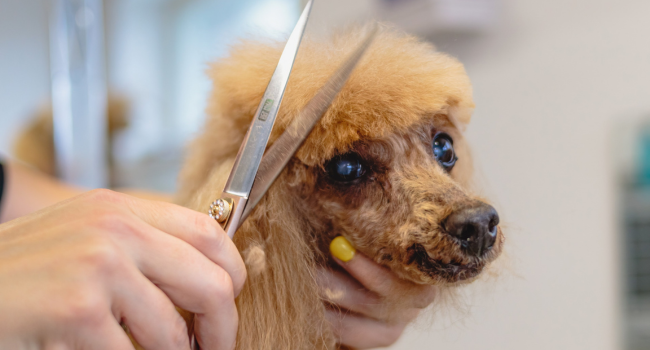
Cheap or dull dog grooming scissors do not cut cleanly through coat. They grip individual hairs and drag through the shaft rather than shearing past it. On curly coats in particular, this creates a repeated pulling sensation across the full length of the session. The dog is not reacting to grooming. It is reacting to what feels, from its perspective, like a sustained series of small pulls. Switching to a properly sharpened scissor with a smooth blade geometry changes that experience entirely.
Heat, Noise and the Clipper Problem
Electric clippers carry their own stressors: motor vibration that travels up the tool and into the hand, a consistent high-frequency noise that sits above the range that feels neutral to most dogs, and blade heat that builds during extended use and presses against sensitive skin. Scissors, used for finish work and detail, produce none of these. They are quieter, cooler and far less invasive for dogs that have already developed a wariness around grooming sessions.
The False Economy of Cheap Grooming Tools
A poor set of tools does not save money over time. It creates a cycle: the dog becomes harder to handle, sessions take longer, corrections are needed more often and professional bookings increase to compensate. For anyone serious about dog grooming at home, choosing quality tools from the start is not an indulgence. It is the practical choice, and if you are ready to reassess what is in your kit, the dog grooming scissor range at EliteTrim offers professional-grade options designed for home groomers who want results without the salon price tag.
Coat Type Decides Everything
Not all coats behave the same way under a scissor, and matching the tool to the coat type is where most at-home dog grooming goes right or wrong before a single cut is made.
Curly and Wool Coats
The Cockapoo is one of the most popular breeds in the UK, and it has one of the most demanding coat types to maintain. Curly and wool coats matt faster than any other texture and are the least forgiving of a blunt blade. The scissor has to be sharp enough to enter the coat cleanly and cut without compressing the curl. Poor blade quality is most visible, and most felt, on this coat type.
Double Coats and the Seasonal Shed
Labradors, Huskies and Border Collies need an undercoat rake to manage the seasonal volume, but they need scissors for the detail work. The guard hairs of a double coat respond differently to blade pressure than the soft undercoat beneath them. A scissor calibrated for one will feel wrong on the other. Experienced home groomers tend to keep two types in rotation for this reason.
Silky and Flowing Coats
Spaniels, Shih Tzus and Maltese carry coats that are as beautiful as they are fragile. A scissor that is too heavy, too dull or too aggressive in its blade tension will split and break fine hairs visibly. The mistakes show immediately and take months to grow out. This coat type rewards the lightest, sharpest scissor in the kit.
Which Scissor Type Does What
A quick reference to help you match the right tool to the coat type in front of you.
Scissor Type
Best Coat Type
Primary Use
Finish Quality
Difficulty Level
Straight scissors
Most coat types
Length reduction, clean lines
Precise, defined
Beginner-friendly
Curved scissors
Curly, wool, rounded areas
Face, paws, body shaping
Soft, blended
Intermediate
Thinning shears
Long, silky, double coats
Texture removal, blending
Natural, graduated
Intermediate
Finishing shears
All coat types
Final detail, flyaway removal
Salon-level
All abilities
The right scissor depends less on personal preference and more on the coat type sitting in front of you. Most home groomers benefit from starting with a reliable straight scissor before adding specialist types to the kit. For those unsure where to begin, the straight dog grooming scissors available from EliteTrim are a considered starting point, engineered for precision across most coat types without requiring professional training to use well.
What Makes a Grooming Scissor Actually Good
Understanding what separates a quality pair of dog grooming scissors from a poor one means looking at the blade itself: the material, the grind and the geometry that determines how it moves through coat.
Japanese Steel and Why It Matters
Japanese-grade steel is harder than most alternatives. Measured on the Rockwell scale, a higher hardness rating means the edge holds its sharpness for longer under repeated use on coarse coat textures. A scissor that dulls quickly after six sessions is not saving money. A well-maintained blade made from quality steel should last years without needing professional sharpening more than once annually. This is the same logic a good hairdresser applies to their shears, and it translates directly to dog grooming.
Convex vs Bevelled Blades
A convex blade is ground to a smooth curve on one face, which allows it to slide through the coat rather than push through it. A bevelled blade has a more angular edge that creates more friction at the cut point. For most coat types, the convex grind produces a cleaner result with less discomfort for the dog. It is the preferred blade type among professional groomers and is increasingly available in tools designed for experienced home users.
Weight, Balance and the Session That Does Not Exhaust You
A heavy scissor requires a tighter grip to maintain control, and a tighter grip means less precision over a longer session. For home groomers who are not cutting daily, this matters more than it might for a professional who has built endurance over years of use. A well-balanced scissor allows for lighter hold and more natural movement. The dog feels the difference in how the hand moves across its body.
Building a Routine the Dog Actually Tolerates
Once the tools are right, the routine becomes the project. Desensitisation is slower with poor tools and faster when the dog learns that the experience does not cause discomfort.
Starting Over With a Dog Who Already Hates It
Reintroducing dog grooming to a dog that has learned to dread it requires patience, but it also requires removing the original cause of the aversion. Short sessions with no agenda beyond letting the dog become comfortable with the tool are a useful starting point. If the scissor was the source of discomfort, replacing it should come before any other part of the retraining process begins.
The Maintenance Session vs the Full Groom
A weekly five-minute session targeting the ears, paws and legs is more valuable to a dog’s overall grooming tolerance than a full groom every six weeks with nothing in between. Regular, brief and comfortable contact builds familiarity. It also keeps the coat in a state where the full session, when it comes, is shorter, calmer and far less demanding for both sides.
The dog that goes rigid at the sight of a grooming brush is not a problem dog. It is a dog that learned, early and clearly, that being groomed is unpleasant. That lesson can be unlearned, but it needs the right conditions. Change the tools first. The behaviour tends to follow. Dog grooming done well is quiet, consistent and, eventually, something neither of you dreads.