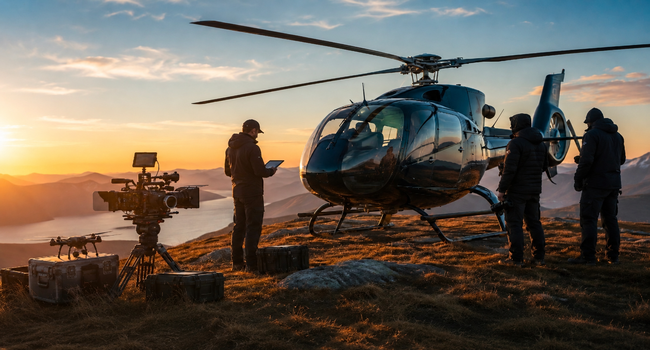
This blog is written for producers, creative directors, and agencies planning aerial work. It focuses entirely on pre-production — platform decisions, airspace coordination, shot planning, timing, and why the conversations that happen weeks before shoot day determine what’s actually achievable once the helicopter is in the air.
Everything That Matters Happens Before Liftoff
The aerial sequences that make it into the final cut without a reshoot attached — those were figured out in pre-production. The ones that didn’t make it were usually planned at the last minute, with the shot list arriving the morning of and the production team expecting to sort out the details in the air. Planning helicopters for film & photo shoots is a pre-production discipline, and the earlier that conversation starts, the more of the creative vision actually survives contact with shoot day.
Helicopter or Drone — Settle This Before the Shot List Exists
Platform selection needs to happen before storyboarding, not after. Helicopters carry heavier camera systems, cover more ground, operate at higher altitudes, and hold a stable shot at speeds drones can’t match. Drones work well for close-proximity detail work and low-altitude sequences where a full aircraft would be impractical. Most serious productions use both — but knowing which sequences belong to which platform changes the shot list, the schedule, and the budget, which is why that decision belongs at the beginning of pre-production rather than the end.
Permits Don’t Wait for the Rest of the Plan to Catch Up
Urban aerial filming runs on paperwork, and New York’s airspace is among the most regulated in the country. FAA coordination, city agency permits, flight plan filings, liability insurance — each of these has its own timeline, and none of them move faster because production is behind schedule. The productions that lose location options or compress their shooting windows almost always started the permitting process too late. Locking permits in parallel with location scouting rather than after is one of the most practical decisions a production coordinator can make.
Light Windows Are Short and Don’t Negotiate
Golden hour over the Hudson runs about 20 minutes on a good day. A sunrise sequence above lower Manhattan has a useful window of maybe 15 minutes before the light shifts into something flat and unusable. Productions that schedule aerial work without mapping the light against the flight time end up either shooting in wrong conditions or eating the cost of a second day. The solution is building the shot schedule around the light windows from the start — which requires knowing exactly which sequences need which quality of light before anyone books the aircraft.
The Shot List Should Be Built With the Operator, Not Handed to Them
A shot list that arrives on shoot day is a list of intentions. A shot list built with the aerial operator during pre-production is a list of executable sequences. Pilots who’ve flown a location know which angles require specific approach paths, where airspace restrictions cut off certain shots, and how long each setup realistically takes at altitude. That information changes what goes on the list and what gets cut. Productions that bring the operator into pre-production planning consistently get more usable footage than those that treat aerial work as execution-only.
Stills and Motion Have Different Requirements in the Air
Private aerial photography flights for commercial and editorial work need specific aircraft configurations — doors-off setup, shooting altitude, shutter speed relative to rotor vibration — that differ from what motion capture requires. Running both on the same flight without planning for both disciplines separately means one of them is going to spend part of the flight adapting to a setup that wasn’t built for them. If a shoot is combining motion and stills, the pre-production conversation needs to address each explicitly and resolve any conflicts in the flight path before shoot day.
Weather Planning Is a Creative Decision, Not an Afterthought
Every aerial shoot needs a contingency plan that’s specific enough to actually use. Which shots are priority if the window compresses? What’s the minimum viable day if cloud cover closes in by mid-morning? Which sequences can move to a backup date without breaking the production? A good aerial operator makes go/no-go calls early — before the crew has mobilized and the day has started burning. The production side of that equation is having answers to those questions ready before they’re needed, not working them out on the phone when conditions are already changing.
The Operator You Choose Shapes All of This
Pre-production only works if the aerial operator actually participates in it. Wings Air Helicopters has worked across feature films, television, commercial productions, and documentaries with SAG-certified pilots and professional cinema camera systems. More relevant for pre-production: they engage before shoot day — on shot planning, location routing, permit coordination, and timing — which is where the work that determines the quality of the footage actually happens.
FAQ
When exactly should an aerial operator be brought into pre-production?
During location scouting, not after locations are locked. What’s achievable from the air — altitude constraints, approach paths, airspace restrictions — directly affects which locations work for aerial sequences and which ones don’t. Having that conversation after the location is already signed off means discovering problems when they’re expensive to fix.
What happens when the shot list changes after permits are already filed?
It depends on how significantly the locations or altitudes change. Minor adjustments within an already-permitted corridor are usually manageable. New locations or substantially different flight paths may require additional permits, which take time that production schedules rarely have at that point. This is one of the clearest arguments for locking aerial plans early — changes in pre-production are cheap, changes after permitting are not.
How do productions typically handle a reshoot when aerial footage doesn’t come together on the day?
Most try to avoid it because the cost of a second aircraft day plus crew plus permit coordination is significant. The productions that minimize reshoots are the ones that planned their priority shots clearly, had a weather contingency already agreed on, and maintained close communication with the aerial operator about what was and wasn’t working during the flight. Reshoots are rarely caused by bad execution — they’re usually caused by insufficient planning about what success actually looked like.
Does the type of camera system matter, or is the pilot the more important variable?
Both matter, and they’re not really separable on a high-end shoot. The camera system determines what image quality is achievable and how stable the footage is at speed and altitude. The pilot determines whether the aircraft can actually execute the sequences the camera is built to capture. A great system with a pilot who doesn’t understand production rhythms produces footage that’s technically clean but creatively frustrating. The combination is what makes a shoot efficient.
Can aerial work be planned around a production that’s already mid-shoot rather than from the beginning?
It can, but it produces a different result. Productions that integrate aerial planning from the start get footage that’s architecturally connected to the rest of the project — the aerial sequences are built to serve the edit. Productions that add aerial work mid-shoot tend to get footage that’s visually strong on its own but harder to integrate. It’s a solvable problem, but it’s a more expensive and creatively constrained version of what pre-production planning from the start would have delivered.
Read more on KulFiy