Table of Contents
The creative landscape has shifted. Editing images used to mean mastering complex software, spending hours on manual adjustments, and having a trained eye for detail. Today, artificial intelligence has rewritten those rules entirely. With the latest generation of AI-powered tools, anyone can produce professional-quality visuals in minutes — no design degree required.
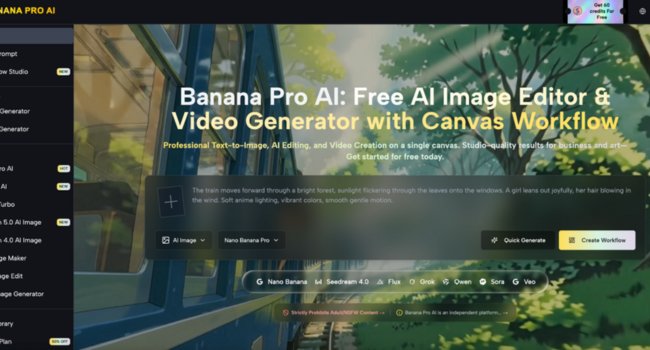
Platforms like BananaproAI AI Image Editor are leading this transformation, bringing together powerful AI models and intuitive interfaces that make sophisticated image editing available to everyone. Whether you’re a solo entrepreneur, a content creator, or a seasoned photographer, AI image editing is no longer a luxury — it’s a competitive necessity.
What Is an AI Image Editor?
Defining Technology
An AI image editor is a software application that uses machine learning, deep neural networks, and computer vision to understand and manipulate digital images. Unlike conventional photo editing tools that require manual input for every change, AI editors analyze the content of an image automatically — recognizing subjects, backgrounds, lighting conditions, and textures — and apply edits intelligently based on that understanding.
How It Differs from Traditional Editing
Traditional editors like Adobe Photoshop give users precise manual control, but that control comes at a cost: time, skill, and significant learning investment. AI image editors flip this equation. They handle the technical complexity behind the scenes, so users can focus on the outcome rather than the process. The gap between intent and result is dramatically narrowed.
Who Is It For?
AI image editors serve an extraordinarily broad audience — from e-commerce businesses automating product photography, to hobbyists wanting better vacation photos, to marketing teams producing campaign visuals at scale. The technology has matured to the point where it genuinely serves both beginners and professionals.
Core Features of a Powerful AI Image Editor
Background Removal and Replacement
One of the most widely used AI editing features is automated background removal. Modern AI can detect and isolate subjects — including complex edges like hair, fur, and transparent objects — with a level of precision that would take a human editor significant time to replicate manually. Once removed, backgrounds can be replaced with solid colors, custom scenes, or entirely new environments.
Portrait Retouching and Enhancement
AI portrait tools can smooth skin, reduce blemishes, brighten eyes, whiten teeth, and reshape facial features — all with natural-looking results. What previously required skilled retouching in Photoshop can now be applied in a single click, with the AI making context-aware adjustments that preserve the subject’s authenticity.
Object Removal and Content-Aware Fill
Need to remove a distracting element from your photo? AI-powered object removal tools can erase unwanted content and intelligently reconstruct the background beneath — filling in the gap with texture and detail that blends seamlessly with the surrounding image.
Image Upscaling and Resolution Enhancement
AI super-resolution algorithms can enlarge low-resolution images while generating realistic detail that wasn’t present in the original file. This is invaluable for restoring old photographs, printing large-format images, or repurposing assets originally captured at lower quality.
Style Transfer and Artistic Filters
Deep learning models trained on thousands of artistic works can transform any photo into a painting, sketch, or stylized illustration. Style transfer features allow users to apply the aesthetic of a specific art movement — impressionism, pop art, anime — to their own photographs with striking results.
Batch Editing and Automation
For users working with high volumes of images, batch processing is a critical time-saver. AI image editors can apply consistent edits — background removal, color correction, resizing — across hundreds or thousands of images simultaneously, dramatically reducing production time for e-commerce catalogs, event photography, and marketing campaigns.

Why BananaproAI Is a Leading AI Image Editor
Powerful Models, Intuitive Interface
Among the platforms redefining this space, the AI image editor from BananaproAI stands out for its combination of technical capability and user-friendly design. The platform integrates multiple AI editing features into a single, clean workspace — no switching between tools, no complex layer management, no steep learning curve.
Accuracy That Handles Real-World Complexity
The AI models powering BananaproAI have been trained on diverse, real-world image datasets, enabling them to handle challenging scenarios that trip up lesser tools: intricate hair details, semi-transparent subjects, mixed lighting conditions, and cluttered backgrounds. The results are consistently clean, natural, and production-ready.
Speed That Changes Your Workflow
Edits that would take 15–20 minutes in traditional software are completed in seconds. For businesses and creators working at volume, that time savings compounds quickly — translating directly into cost savings, faster turnaround times, and the ability to produce more content without adding resources.
AI Image Editor vs. Traditional Software
Strengths of AI Editing
AI image editors excel at speed, consistency, and accessibility. They democratize professional-quality results, making them available to users without formal design training. For high-volume, repeatable tasks, AI is simply faster and more cost-effective than manual editing.
Where Traditional Tools Still Lead
Professional tools like Adobe Photoshop or Lightroom remain the gold standard for complex, highly customized creative work. When precise manual control, advanced compositing, or deep color science is required, traditional software still holds the edge.
The Smartest Approach: Use Both
The most effective creative workflows in 2025 combine AI and traditional tools. Use AI for speed, volume, and routine tasks; use traditional software for bespoke, high-stakes creative work. The two are complementary — not competing.

The Future of AI Image Editing
Generative AI Is Expanding What’s Possible
Generative AI is pushing the boundaries of image editing beyond correction and cleanup. Tools can now generate entirely new visual elements from text prompts, extend the edges of photos with realistic content, or reimagine a scene in a different season, lighting condition, or artistic style. These capabilities are rapidly moving from novelty to standard workflow feature.
AI Editing Is Becoming Ubiquitous
Expect AI image editing to become embedded across the creative stack — built into cameras, smartphones, social platforms, and content management systems. The friction between capturing and sharing a polished image will continue to shrink, and the tools investing in model quality and accessibility today will define the standard tomorrow.
Final Thoughts
AI has redefined what it means to edit an image. The barriers of skill, time, and cost that once kept professional-quality editing out of reach for most users have been dismantled. Whether you’re processing product photos, building a social media presence, or simply trying to make your images look their best, a capable AI image editor is now one of the most valuable tools in your creative toolkit.
For anyone ready to experience that difference, the AI image editor at BananaproAI delivers the quality, speed, and simplicity that modern image editing demands. Start editing smarter — visit BananaproAI and see what AI can do for your images today.