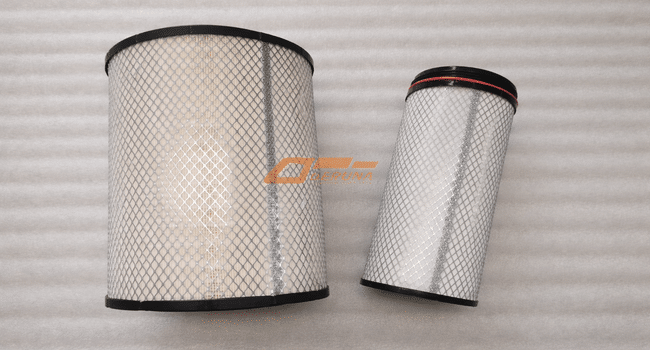
The global heavy-duty trucking industry relies on the robustness of Sinotruk Howo vehicles. From the construction sites of the Middle East to the mining operations in Africa and the long-haul routes across Southeast Asia, these trucks are the backbone of commerce. However, the performance and longevity of your Howo truck hinge on a component that is often overlooked and frequently counterfeited: the air filter.
The market is flooded with fake **Howo Air Filters**. These counterfeits are not just harmless replicas; they are engineered failures waiting to happen. Installing a counterfeit **Howo Air Filter** can lead to catastrophic engine wear, reduced fuel efficiency, and thousands of dollars in unnecessary repairs. But how do you protect your investment? While there are many ways to spot a fake, this guide will focus on one simple, foolproof trick that, combined with expert knowledge, will ensure you always get the genuine article.
## The High Stakes of Air Filtration
Before diving into the identification trick, it is critical to understand why the air filter is so important. Your Howo engine is essentially a high-performance air pump. For every gallon of diesel burned, your engine consumes approximately 15,000 gallons of air . This air is sucked in from the environment, which is filled with abrasive dust, sand, and debris.
A high-quality **Howo Air Filter** acts as the lungs of your engine. Its job is to trap these contaminants before they enter the combustion chamber. According to industry data, a premium filter achieves an efficiency rating of **99.97% for particles down to 5 microns** . This means that only 0.03% of harmful particles theoretically pass through. When this efficiency drops, the results are disastrous.
### What Happens When Filtration Fails?
If a filter fails or is fake, abrasive dust acts like sandpaper on the internal components.
– **Cylinder Wear:** Particles score the cylinder walls, breaking the seal between the piston rings and the cylinder. This leads to blow-by (combustion gases escaping into the crankcase) and a massive loss of power.
– **Turbocharger Damage:** The turbocharger spins at hundreds of thousands of RPMs. Ingesting dust acts like a sandblaster on the compressor wheel blades, eroding their edges and destroying balance, which leads to bearing failure.
– **Oil Contamination:** Dirt that gets past the pistons contaminates the engine oil, turning it into a grinding paste that wears out bearings on the crankshaft and camshaft.
A study on filtration concepts notes that if the initial interception efficiency of a filter drops, the volume of impurities entering the engine can increase exponentially, leading directly to “pulling the cylinder”—a condition that requires a complete, expensive engine overhaul . Using a counterfeit **Howo Air Filter** makes this catastrophic failure a near-certainty.
## The Anatomy of a Genuine Howo Air Filter
To spot a fake, you must first know what genuine looks like. A real **Howo Air Filter** is a precision piece of engineering. For common Howo models, part numbers like **WG9725190102 (Primary)** and **WG9725190103 (Safety)** are standard . For the Howo A7 and T7H series, you might be looking at radial seal cylindrical filters like the K3250 or K3046 variants .
Here is what genuine **Howo Air Filters** are made of:
1. **Multi-Layered Media:** Genuine filters use a blend of treated cellulose fibers and synthetic materials. The media is pleated to increase the surface area, allowing for high dust-holding capacity without restricting airflow .
2. **Reinforced Structure:** Inside the element, you will find a galvanized mesh or a rigid plastic core (holding frame). This prevents the filter from collapsing under the high vacuum pressure created by the turbocharger .
3. **Precision Seals:** The polyurethane or rubber gasket seals are flexible yet firm. They are designed to create an absolute seal against the housing, preventing “air bypass”—a condition where unfiltered air sneaks around the filter element .
4. **Dual-Stage Systems:** Many Howo trucks use a two-stage system: a primary filter and a safety filter (secondary) . The safety filter is a backup. If the primary is damaged, the safety filter catches the debris. In genuine systems, both are manufactured to exacting OEM standards.
## The “One Simple Trick” to Spot Fake Howo Air Filters
While there are many warning signs (flimsy packaging, low price, poor printing), the single most effective trick to verify authenticity is **The “Compression and Seal” Test.**
This test focuses on the physical integrity of the filter’s structural components, specifically the **end caps** and the **gasket seal**.

Here is how to perform it:
1. **The Squeeze Test:** Take the filter and place it on a flat surface. Apply firm, downward pressure on the top end cap. A genuine **Howo Air Filter** will feel solid and resist compression. The end caps, usually made of durable thermoplastic or metal, are bonded tightly to the filter media .
2. **The Gasket Palpation:** Run your finger along the rubber gasket seal where it meets the housing. A genuine gasket, made from EPDM or silicone rubber, should feel dense, smooth, and have a consistent profile . Press your thumbnail into it. It should resist indentation and spring back quickly. It should not feel like soft, squishy foam or hard, brittle plastic.
3. **The “Flex” Check:** Try to gently twist the filter media relative to the end cap. In a genuine filter, the adhesive bond is incredibly strong. There should be zero movement. In a counterfeit, you might feel a slight “give” or hear a cracking sound, indicating poor gluing.
### Why This Trick Works
Counterfeiters are good at copying colors and printing logos, but they cut costs on raw materials. The polyurethane used in cheap end caps and gaskets is often of low quality. It degrades quickly, hardens in the sun, or remains too soft.
When you install a filter with a soft or brittle gasket, you are guaranteeing an air leak. Even the tiniest gap allows unfiltered air, laden with dust, to rush directly into your engine. Furthermore, if the end caps aren’t bonded properly, the filter media can separate from the frame, collapsing into the intake stream and starving the engine of air or sending debris downstream.
This simple physical test takes 10 seconds but reveals the quality of the materials used. A genuine **Howo Air Filter** is built to withstand temperature extremes from -40°C to +120°C and the intense vibration of a heavy-duty diesel engine . A fake simply isn’t.
## Visual Inspection: The Supporting Evidence
While the physical compression test is your primary weapon, combine it with these visual checks to build a bulletproof case for authenticity.
### 1. The Pleating Pattern
– **Genuine:** Pleats are uniform, evenly spaced, and rigid. The glue lines holding the pleats in place are consistent and neat .
– **Counterfeit:** Pleats may be uneven, collapsing, or spaced irregularly. Glue may be sloppily applied, dripping onto the media, which blocks airflow.
### 2. The Media Itself
– **Genuine:** Look for a deep, fibrous texture. High-quality **Howo Air Filters** use media with a specific resin treatment to resist moisture and optimize pore size .
– **Counterfeit:** The paper often looks like standard cardboard. It may be brittle, or conversely, have large pores visible to the naked eye, indicating it cannot capture fine particles .
### 3. The Part Number and Printing
– **Genuine:** Part numbers like WG9725190102 or WG8710360014 are stamped or printed clearly. The font is crisp, and the ink adheres well .
– **Counterfeit:** Printing might be smudged, use the wrong font, or be placed incorrectly on the filter.
### 4. The Safety Filter
– **Genuine:** If you purchase a set including the safety filter (inner element), it will be well-made. The safety filter is not meant to be cleaned; it is a backup. Genuine safety filters are precisely dimensioned.
– **Counterfeit:** Often, counterfeiters sell a cheap primary filter with an even cheaper, poorly fitted safety filter, or they omit the safety filter entirely, leaving the engine vulnerable.
## The Cost of Being Wrong: Why Cheap is Expensive
The initial price difference between a counterfeit and a genuine **Howo Air Filter** can be tempting. A fake might cost $15-$20, while a genuine OEM or high-quality equivalent might cost $40-$60. However, the math is brutally simple.
Consider the cost of a turbocharger replacement: $1,500 – $3,000.
Consider the cost of an engine overhaul: $10,000 – $20,000.
A high-quality **Howo Air Filter** provides up to 30% longer service intervals and can improve fuel economy by 3-5% simply by ensuring the engine breathes easily . This fuel savings alone pays for the filter many times over.
One fleet manager operating in a copper mine reported that after switching to genuine filters, they “eliminated turbo failures” . The cheap filter is false economy. It is an investment in future downtime.
## Choosing the Right Type for Your Environment
Identifying a genuine filter is step one. Step two is selecting the correct type of **Howo Air Filter** for your operating conditions.
### Standard On-Highway Use
For standard highway hauling, a high-quality paper (cellulose) filter is sufficient. It offers high filtration efficiency and is cost-effective . Look for the standard part numbers like WG9725190102.
### Off-Road, Mining, and Desert Conditions
If your Howo operates in a dusty, harsh environment, you need a heavy-duty solution.
– **Synthetic Media:** Filters made with synthetic fibers offer better moisture resistance and durability .
– **Dual-Stage Filtration:** Consider using a system with a pre-cleaner or an oil bath assembly (like part number WG9730195801) to handle large debris before it reaches the main filter . This extends the life of your primary **Howo Air Filter** significantly.
– **Cylinder Filters:** For turbocharged Howo engines with limited space, cylinder filters provide high airflow and are often used in these models .
### Humid Climates
In high-humidity regions, a filter with hygroscopic paper or electrostatic synthetic fibers can help trap moisture and fine particulates more effectively .
## Maintenance: Beyond the Purchase
Buying a genuine **Howo Air Filter** is not the end of the story. Proper maintenance is key to engine longevity.
### Inspection Intervals
– **Normal Conditions:** Inspect the filter housing and check the restriction indicator every 10,000 km .
– **Severe Conditions:** In dusty environments, inspect every 2,000 km .
– **Replacement:** Standard filters typically need replacement every 20,000–30,000 km, but this varies wildly based on dust load. In mines, it might be as low as 10,000 km .
### The Cleaning Rule
– **Primary Filter:** Paper elements can sometimes be cleaned 2-3 times using low-pressure compressed air (less than 5 bar). **Always blow from the inside out** to force debris out of the pleats . Never tap or wash the filter.
– **Safety Filter:** **Never clean the safety filter.** It should be replaced every time you replace the primary filter .
### The “Restriction Gauge”
Your Howo truck likely has a restriction gauge or indicator. This measures the vacuum inside the intake system. When the gauge shows red or reaches a specific pressure (like 6.25 kPa), it is time to replace the filter, regardless of mileage . Do not guess; use the gauge.
## Sourcing: Where to Buy Genuine Parts
To ensure you are getting a genuine product, you must buy from reputable sources.
– **Authorized Dealers(Deruna Heavy Truck Parts Co., Ltd.):** The safest bet is to purchase from authorized Sinotruk dealers or their official distributors in your country.
– **Reputable Online Suppliers:** If buying online, look for suppliers with a long track record. Companies based in Shandong province, near the Sinotruk factory, often have direct access to genuine parts. Websites like **chinaheavytruckparts.com** offer parts that meet or exceed OEM specifications and provide detailed technical data and support .
– **Red Flags:** Be wary of prices that are significantly lower than the market average. If a deal seems too good to be true on sites like Alibaba or local markets, it almost certainly is. Check for verified badges and Trade Assurance protection.
When contacting a supplier, always provide your truck’s VIN or the part number from your old filter (e.g., WG9725190102). A good supplier will confirm compatibility based on this data, not just on the truck model name .
## The Technology Behind the Filter
Understanding the technology reinforces why the “one simple trick” matters.
– **Filtration Efficiency:** Genuine **Howo Air Filters** are rated to capture particles as small as 5 microns with 99.5% to 99.97% efficiency . Human hair is about 70 microns. This level of precision requires high-grade media.
– **Initial vs. Full-Life Efficiency:** Interestingly, a new filter does not have its highest efficiency. The “initial interception efficiency” is slightly lower than the “full life efficiency.” As the filter runs, dust builds up on the media fibers, actually making the pores smaller and increasing the filter’s ability to catch particles (up to 9.5 times more effective) . This is why replacing filters too frequently (before the restriction gauge says so) can actually allow *more* impurities into your engine during the “break-in” period of the new filter.
This counterintuitive fact highlights the sophistication of air filtration engineering. It is not just a screen; it is a dynamic medium.
## Conclusion: Protect Your Investment with Vigilance
Your Howo truck is a significant capital asset. Protecting it requires vigilance in every aspect of maintenance, starting with the air intake system. Counterfeiters are becoming more sophisticated, but they have not yet mastered the material science required to replicate the structural integrity of a genuine **Howo Air Filter**.
Remember the one simple trick: **The Compression and Seal Test.** Squeeze the filter. Feel the end caps. Press the gasket. If it feels weak, soft, or brittle, reject it. Combine this with a visual inspection of the pleating and media, and source your parts from trusted suppliers who can verify part numbers like WG9725190102 or WG8710360014.
Investing in a genuine **Howo Air Filter** is not an expense; it is a safeguard. It ensures optimal combustion, maximum fuel efficiency, and most importantly, it keeps abrasive dust away from the tight tolerances of your engine’s cylinders, pistons, and turbocharger. By choosing authenticity, you choose reliability, lower operating costs, and a longer life for the truck that drives your business forward. Don’t let a cheap fake undo thousands of hours of hard work. Your engine’s life depends on the air it breathes.
Read more on KulFiy