Table of Contents
If you have ever looked at a solar power bank and wondered whether the solar panel is truly useful, you are asking the right question.
For years, many solar power banks followed the same basic design: a battery pack with a small solar panel fixed to the outside. That design is simple, but it also creates a real limitation. The solar panel and the battery have to go everywhere together, even when you only need one of them.
A detachable solar power bank changes that relationship. Instead of treating the solar panel and the battery as one permanent object, it lets them work together or separately. That matters more than it may seem, especially for camping, hiking, road trips, travel days, outdoor events, and emergency phone backup.
The difference is not only about specs. It is about how power fits into real life.
What Is a Fixed Solar Power Bank?
A fixed solar power bank is a power bank with a solar panel permanently attached to the battery body.
This design can make sense for simple backup use. The battery stores power, and the solar panel can help collect energy when there is enough sunlight. For someone who wants one self-contained device and does not mind carrying the whole unit every time, a fixed design is easy to understand.
With a fixed solar power bank, the solar panel and the battery are always together. If you want to place the solar panel in the sun, the battery usually has to sit there too. If you want to carry only the battery for a commute, cafe visit, or short day trip, the panel comes along whether you need it or not.
That is not a failure of fixed solar power banks. It is simply the tradeoff of the design.
What Is a Detachable Solar Power Bank?
A detachable solar power bank separates the solar collection part from the battery storage part.
The solar panel can collect sunlight, while the power bank can be used as a standalone charger. When you need the full outdoor setup, the two parts work together. When you only need a daily power bank, you can carry the battery side on its own.
This is the core idea behind Detachable Personal Solar Power: solar energy close enough to carry, with battery storage flexible enough to use every day.
For phones, tablets, and small electronic devices, that flexibility can matter more than simply buying the biggest battery or the largest power system.
The Main Difference: Carrying Everything vs Carrying What You Need
The biggest difference between detachable and fixed solar power banks is not the solar label. It is how much control you have over the setup.
With a fixed solar power bank, you carry the whole device every time. That can be fine on a camping trip, but it may feel unnecessary during a normal weekday when you only want backup phone power.
With a detachable solar power bank, you can choose the mode:
- Daily carry mode: bring only the power bank.
- Outdoor mode: bring the solar panel and power bank together.
- Sunlight mode: position the solar panel for sun while using or carrying the power bank separately.
- Backup mode: keep the modular setup ready for travel, outdoor days, or power interruptions.
This is where detachable design becomes practical. It does not ask you to treat every day like a camping trip.
Where Fixed Solar Power Banks Work Well
Fixed solar power banks are still useful in several situations.
They are simple. There are fewer parts to manage, and the solar panel is always attached. If your priority is a single backup device for occasional outdoor use, that simplicity may be enough.
They can also be convenient for people who do not want to think about separate pieces. Everything stays together in one unit, so there is less risk of leaving the panel behind.
A fixed design may be the better choice if:
- You rarely use a power bank outside of outdoor trips.
- You want the simplest possible device.
- You do not mind carrying the solar panel every time.
- You only expect solar charging to be a backup feature.
- You do not need to place the panel and battery in different locations.
The key is expectation. A fixed solar power bank can be useful, but it is less adaptable.
Where Fixed Designs Can Feel Limiting
Fixed solar power banks become less convenient when real life gets more varied.
Imagine a road trip. You may want the solar panel near a sunny window or outside at a campsite, but you may also want the power bank in your bag, tent, car, or pocket. With a fixed design, those two needs compete with each other.
Or think about daily carry. On most weekdays, you may only need a compact battery for your phone. Carrying a solar panel you do not plan to use can feel like extra bulk.
The same problem shows up during outdoor activities. When hiking, fishing, or spending time at an outdoor event, sunlight access changes during the day. A detachable panel can be positioned for better exposure while the battery remains available for charging devices. A fixed unit gives you fewer options.
That is the practical problem detachable solar power banks are designed to solve.
Why Detachable Design Changes the Use Case
Detachable design makes a solar power bank more modular.
Instead of one object trying to do everything in one place, the product can support different moments:
- The solar panel can sit where sunlight is better.
- The power bank can stay close to the person using it.
- The full setup can be packed for outdoor trips.
- The battery alone can be carried during normal daily movement.
That flexibility is especially useful because solar charging depends on conditions. Sunlight, weather, angle, shade, temperature, and device use all affect performance. A detachable design does not remove those limits, but it gives users more control over where and how the panel is used.
In other words, detachable solar charging is not about promising unlimited power. It is about making solar and stored power fit the day more intelligently.
Example: How Solupup PBS47K Approaches the Category
Solupup PBS47K is built around this detachable idea.
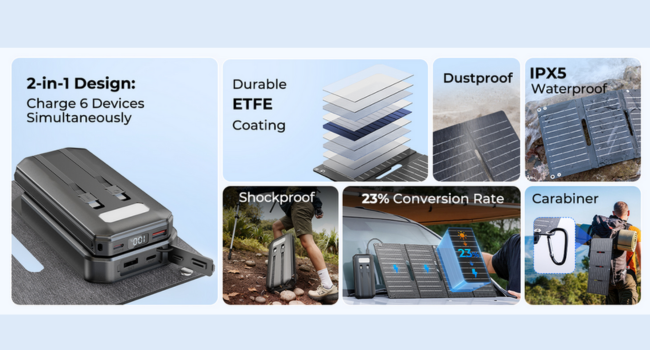
It combines a 15W four-fold solar panel with a 10000mAh lithium polymer power bank. According to the PBS47K brief, the solar panel and power bank can be used independently. The solar panel includes Type-C and USB-A outputs for direct charging in sunlight, while the power bank includes Type-C, USB-A, a built-in Lightning cable, and a built-in Type-C cable.
For charging convenience, the brief lists Type-C PD output up to 20W and USB-A QC output up to 22.5W. The full unit weighs 1.45 lb / 658g, and the power bank itself measures 5.91 x 2.76 x 0.71 inches. PBS47K is also rated IPX5 according to the brief, which should be described as water-resistant or splash-resistant, not submersible.
The important part is not that PBS47K tries to replace a large portable power station. It does not. It is designed for smartphones, tablets, and small electronic devices.
The product makes the most sense when the user wants two modes in one setup:
- A standalone power bank for daily carry.
- A solar-supported charger for outdoor and backup situations.
That is the difference between simply adding a solar panel and designing around detachable use.
Detachable vs Fixed Solar Power Bank: Quick Comparison
| Feature | Fixed Solar Power Bank | Detachable Solar Power Bank |
| Basic design | Solar panel is permanently attached to the battery | Solar panel and power bank can work together or separately |
| Daily carry | Whole unit comes along | Power bank can be carried by itself |
| Solar placement | Battery and panel usually stay in the same place | Panel can be positioned for sunlight while the battery remains useful |
| Outdoor flexibility | Simple but less adaptable | More flexible for camping, hiking, fishing, road trips, and outdoor events |
| Best for | Users who want one simple device | Users who want modular charging for different situations |
| Main tradeoff | Less flexible | More parts to manage |
Neither design is automatically better for everyone. The better choice depends on how you actually use portable power.
Which One Should You Choose?
Choose a fixed solar power bank if you want the simplest possible backup device and you do not mind carrying the solar panel with the battery every time.
Choose a detachable solar power bank if your days change. If you commute during the week, travel on weekends, spend time outdoors, or want a small-device backup option for emergencies, detachable design gives you more ways to use the same product.
A detachable solar power bank is especially worth considering if:
- You want a normal power bank for everyday use.
- You want solar support for camping, hiking, fishing, or road trips.
- You want to place the solar panel in sunlight without tying up the power bank.
- You prefer one modular setup over buying a separate panel and separate battery.
- You mainly need power for phones, tablets, and small electronic devices.
If you need to run high-wattage appliances, refrigerators, tools, CPAP machines, or home backup systems, a solar power bank is the wrong category. You should look at larger power solutions with verified output and capacity for those devices.
A Practical Buying Checklist
Before buying any solar power bank, ask these questions:
- What devices do I actually need to charge?
- Do I need solar charging often, or only as a backup?
- Will I carry this daily, or mostly outdoors?
- Does the solar panel have enough useful area for my expectations?
- Can the solar panel and battery work separately?
- What ports and cables do I need?
- Is the water-resistance rating clearly stated?
- Are the solar charging claims realistic and condition-dependent?
- Am I expecting phone backup, or am I really shopping for a larger power station?
For many people, the best answer is not the largest power system. It is the setup they will actually carry, position, and use.
That is why detachable design deserves attention.
Conclusion
A fixed solar power bank is simple: the panel and battery stay together. That can be useful, especially for occasional backup power.
A detachable solar power bank is more flexible: the solar panel and battery can work as a team or separately. That makes it better suited to real movement, where the best place for sunlight is not always the best place for your phone, bag, or charging cable.
For phones, tablets, and small electronic devices, detachable design can turn a solar power bank from a novelty feature into a more practical everyday and outdoor charging setup.
Solupup PBS47K fits that idea with a 15W four-fold solar panel, a 10000mAh removable power bank, built-in Lightning and Type-C cables, PD and QC charging support, and an IPX5-rated design according to the product brief. It is not a replacement for a portable power station, but it is a useful example of Detachable Personal Solar Power for people who want backup energy that adapts to the day.
Solar charging depends on sunlight, weather, angle, and usage conditions. Always check Solupup PBS47K specifications and your device requirements before use.
FAQ
What is a detachable solar power bank?
A detachable solar power bank is a portable charging setup where the solar panel and battery can work together or separately. This lets the solar panel collect sunlight while the power bank remains useful as a standalone charger.
Is a detachable solar power bank better than a fixed solar power bank?
It depends on how you use it. A fixed solar power bank is simpler, while a detachable solar power bank is more flexible. Detachable design is usually more useful for people who want both daily carry and outdoor solar support.
Can a detachable solar power bank replace a portable power station?
No. A solar power bank is generally for phones, tablets, and small electronic devices. It should not be treated as a replacement for a portable power station, solar generator, or whole-home backup system.
Does solar charging work in cloudy weather?
Solar charging depends on sunlight, weather, angle, and other conditions. Cloudy weather can reduce solar performance. Avoid any product that promises the same charging result in all conditions.
Is IPX5 waterproof?
IPX5 means water resistance against water jets or splashes under defined test conditions. It should not be described as submersible. For PBS47K, use water-resistant or splash-resistant language based on the brief.
Can Solupup PBS47K charge laptops?
Do not assume broad laptop compatibility. PBS47K’s verified Type-C output is up to 20W PD according to the brief. Some laptops require more power, so laptop charging claims should be checked against the specific device requirement.