Table of Contents
There was a time when a luxury home in Bangkok meant a large plot, imported materials, and a prestigious postcode. Those things still matter, but they no longer tell the whole story. The buyers shaping today’s high-end residential market have a more demanding and more holistic definition of luxury, and the communities that understand this are pulling ahead of those that don’t.
What has changed is not the appetite for quality. It’s the scope of what quality is expected to include.
The Ecosystem, Not Just the Address
The shift worth paying attention to is the move from evaluating a property in isolation to evaluating the entire environment around it. Buyers at the top of the market are increasingly asking not just “is the house beautiful?” but “what does life actually look like here on a Tuesday morning, or on a school holiday, or when my parents come to stay for a month?”
That question opens up a much wider checklist. Green space, walkability, healthcare proximity, educational options, dining, recreation, wellness, community programming, all of these feed into a picture of daily life that a floor plan simply cannot convey. The most competitive luxury community Bangkok developments have understood this and have built accordingly.
This is what buyers mean when they talk about an ecosystem. Not a single amenity or a standout feature, but a layered environment where different members of a household, across different ages and different needs, can each find something that makes their daily life better.
Multi-Generational Living Is Reshaping the Brief
One of the most significant drivers of this shift in Thailand is the enduring importance of multi-generational households. Thai families, including affluent ones, frequently make residential decisions that need to accommodate grandparents, parents, and children under the same roof or within the same community. That changes the brief considerably.
A development designed purely for young professional couples with sleek, minimalist finishes and a rooftop bar does not serve a family where the grandparents need flat terrain and easy access to wellness facilities, the parents need quiet and space to work from home, and the children need safe outdoor space and a school nearby. A genuine luxury community near Bangkok has to answer to all of those users simultaneously.
This is harder to design than it sounds. It requires scale, because you cannot fit a Par 3 golf course, an onsen, a children’s play area, a co-working space, and a 10-kilometre walking trail on a small plot. It requires thoughtful programming, because proximity alone does not create a functioning community. And it requires a developer with the conviction to invest in amenities that may not directly generate revenue but significantly affect quality of life.
What Each Generation Is Actually Looking For
Breaking it down by generation helps clarify what a well-rounded luxury community needs to deliver.
For older residents and grandparents, the priorities tend to cluster around safety, ease of movement, wellness access, and a calm environment. Noise, traffic, and physical barriers become more relevant at this stage of life. An onsen or spa facility, flat walking paths, and reliable on-site security all register strongly with this group. Being able to visit children and grandchildren without navigating Bangkok traffic is itself a significant quality-of-life improvement.
For parents in their thirties and forties, the drivers are typically a combination of practical and aspirational. School access is often the single biggest constraint; many families build their entire residential geography around where their children are enrolled. Beyond that, working-from-home infrastructure, fitness facilities, and a social environment with peers in a similar life stage all contribute to the decision.
For children and teenagers, the calculus is different again. Safe cycling and running routes, sports facilities, and a community with enough density to have peers nearby all matter. As children grow into teenagers, the question of social life within the community becomes more relevant, a development with only forty or fifty homes can feel isolating for younger residents.
A community that can genuinely serve all three groups within a single address is rare. The ones that do it well tend to attract long-term residents rather than buyers who move on after a few years.
The Amenity Arms Race Has Raised the Floor
It is worth acknowledging that the baseline in Bangkok’s luxury residential market has risen sharply over the past decade. Features that were considered premium additions five years ago, smart home systems, underground cable infrastructure, and co-working spaces within the clubhouse are now standard expectations at a certain price point.
This raises the question of what actually differentiates a luxury community today, when the basics have been commoditised.
The honest answer is execution and integration. Two developments can both list a gym, a golf course, and a swimming pool in their brochure. The difference lies in how those facilities are managed, how well they connect to each other, and whether the overall environment feels coherent and liveable or fragmented and underused. Buyers who tour multiple communities quickly develop a sense for the difference between a beautifully staged show unit surrounded by half-finished amenities and a community that actually functions as described.
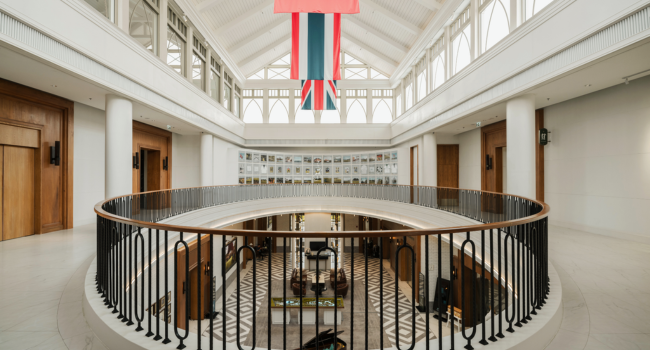
Design coherence matters here too. A luxury community where the residential architecture, the landscaping, the clubhouse design, and the public realm all speak a consistent visual language feels fundamentally different from one where each element was designed in isolation.
Reignwood Park: Built for the Whole Family
Among the large-scale developments currently active near Bangkok, Reignwood Park is one of the more complete examples of the multi-generational community model in practice.
The development spans a substantial land area and houses multiple residential collections under a single master plan, each calibrated for a different buyer profile. The ESTATE collection caters to buyers seeking bespoke mansions with living spaces from 1,500 square metres, designed in collaboration with firms including PIA, A49, and Aesthetic Architect. SERENO offers family-scale homes of around 309 square metres with five bedrooms and direct access to the Par 3 course, designed with multi-generational households specifically in mind. SONIA brings the same access to shared facilities to a larger number of homes at a more accessible price point.
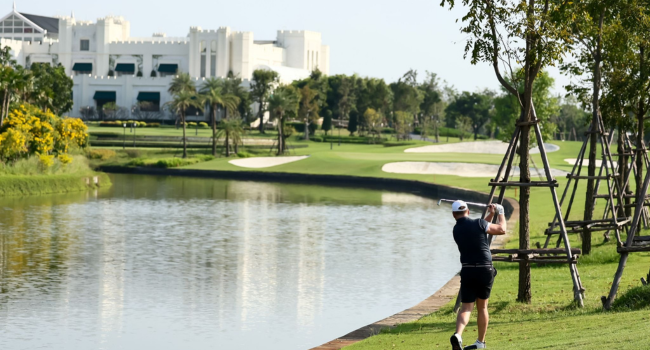
What holds the community together is the shared amenity layer: a golf course, an onsen, a gym, a co-working space, a 10-kilometre walking and cycling track, and global membership privileges that extend to Wentworth Golf Club in London and Reignwood Pine Valley in Beijing. These are not features that appeal to a single demographic. They span generations, the walking track and onsen for older residents, the co-working space and gym for working parents, the golf and cycling infrastructure for active residents across age groups.
For a Thai family evaluating where to consolidate multiple generations under one address, that breadth is not incidental. It is the point.
The City Centre Comparison
It is worth being direct about the trade-off that buyers in this market are consciously making. Choosing a master-planned community outside the city centre means accepting some distance from Bangkok’s commercial and cultural core. That distance is real, and for some buyers it is genuinely disqualifying.
But for others, the calculation runs the other way. The city centre offers proximity and convenience, but it cannot offer 182 rai of landscaped community space, a private golf course, or 10 kilometres of traffic-free cycling. It cannot offer the kind of quiet that genuinely allows children to play outside or elderly residents to walk without navigating traffic. And it increasingly cannot offer the space that multi-generational households actually need.
The buyers choosing luxury communities outside Bangkok are not retreating from the city. They are making an active choice that the lifestyle infrastructure available outside the centre now exceeds what the centre can realistically deliver for families at this stage of life. For many of them, that calculus has become increasingly straightforward.
What Comes Next
The next generation of luxury community development in Bangkok will likely push further on two fronts: educational infrastructure integrated directly into the master plan, and healthcare access either on-site or under formal partnership arrangements. Both represent significant gaps in even the best current offerings, and developers who close those gaps will have a compelling answer to the question of why any affluent family would choose city-centre living over a complete community outside it.
For now, the market is in a transition period where buyer expectations are running slightly ahead of what most developments can deliver. The communities closing that gap most quickly are the ones worth watching.