Table of Contents
The digital landscape of 2026 is moving at a breakneck pace. For content creators, the era of heavy desktop software suites and high-barrier production is rapidly fading into the rearview mirror. Today, influence is no longer defined by massive production budgets; it is defined by Speed, Agility, and Privacy.
As we navigate through 2026, the primary challenge for creators isn’t finding tools—it’s finding the right tools that don’t slow down the creative momentum. While traditional Digital Audio Workstations (DAWs) offer immense power, they often come with steep learning curves and hardware demands that hinder the rapid-fire nature of modern social media. The solution? A new wave of “Surgical” media utilities.
The Death of the “Upload-Process-Download” Cycle
For over a decade, “the cloud” was touted as the ultimate solution for media editing. However, as video resolutions have scaled to 8K and audio fidelity has reached lossless standards, the cloud-first model has hit a wall.
Consider the friction in a typical creator’s workflow: you have a 2GB 4K video file recorded on your mobile device, and you only need to extract a 15-second soundbite for an Instagram Reel. In the legacy cloud model, you would have to upload that entire 2GB file, wait for server-side processing, and then download the result. This consumes bandwidth, wastes time, and creates a significant security risk.
The breakthrough of 2026 is Local-First Browser Processing. Powered by WebAssembly (WASM), platforms like audio cut allow your browser to act as a high-performance workstation. By utilizing your device’s local CPU and RAM, these tools read your media files instantly without ever sending them to a remote server.
The Three Pillars of the 2026 Creator Workflow
To stay competitive in 2026, creators are integrating specialized, browser-based modules into their daily routines. Based on the latest utility-first platforms like AudioCut.io, here is how to redefine your production pipeline:
1. Surgical Extraction: Moving from Video to Audio Instantly
The first step in many social media workflows is repurposing long-form content. Whether it’s a webinar, a YouTube interview, or a recorded stream, the Extract Audio module has become a daily necessity. Unlike old-school converters that re-encoded files and lost quality, modern audio cut utilities “strip” the audio track from the video container in real-time. This allows you to grab a high-fidelity WAV or MP3 track from a massive MP4 file in seconds, ready for immediate use in your next short-form project.
2. AI-Driven Isolation: The Power of Splitter AI
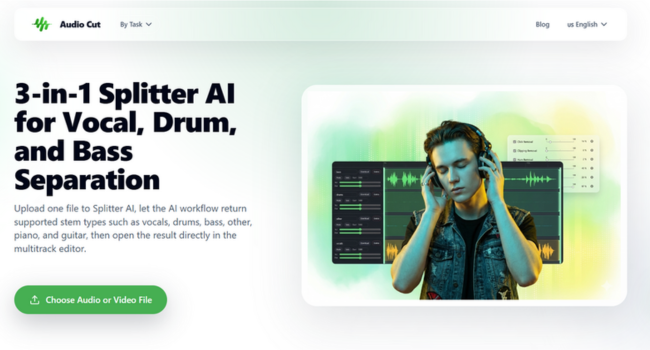
Artificial Intelligence has moved from a gimmick to a fundamental creative tool. One of the most significant breakthroughs for creators is the Splitter AI. Previously, isolating a clean vocal track from a background song required professional sound engineering.
In 2026, client-side neural networks can perform this “Stems Separation” directly in the browser. Creators can now:
- Isolate Vocals: Get a clean voiceover for a remix or a dubbed version.
- Remove Copyrighted Music: Strip background tracks to avoid platform strikes while keeping the original speech.
- Extract Instruments: Isolate a drum beat or a bassline for original music production. Because this happens locally, your raw intellectual property remains strictly under your control.
3. Seamless Narrative Building: Audio Merge & Refinement
Efficiency is found in the final assembly. The Audio Merge function allows creators to bypass complex multi-track timelines for simple layering. By visually stacking voiceovers, ambient soundscapes, and AI-isolated tracks, you can blend and balance your narrative in a streamlined interface. When combined with an Audio Compressor, you can ensure your final output is optimized for platform-specific bitrates without sacrificing the “punch” of your sound.
Data Sovereignty: The Creator’s New Priority
Beyond speed, 2026 has brought a renewed focus on Data Sovereignty. With AI models constantly scraping the web for training data, creators are becoming more protective of their unreleased assets.
Using a “Zero-Upload” station means your unreleased podcasts, internal corporate interviews, or exclusive sound designs never touch a third-party server. This 100% private approach is not just a technical feature; it is a fundamental right for the modern digital worker. By performing an audio cut locally, you ensure that your metadata and your content remain yours alone.
Conclusion: The Future is Decentralized
The barriers to entry for professional content creation have effectively vanished. The “Studio” of 2026 is no longer a physical room—it is a fast browser and a surgical toolkit. By embracing local-first, WASM-powered utilities, creators can reclaim their most valuable asset: Time.
Whether you are a solo vlogger or part of a corporate marketing team, the shift to browser-side processing is your gateway to scaling content without scaling costs. The future of creative work is decentralized, private, and faster than ever before.